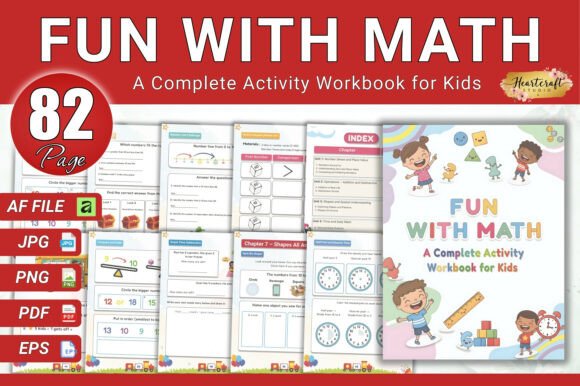
Fun with Math – A Complete Activity Workbook
Math doesn’t have to be a chore. With Fun with Math – A Complete Activity Workbook for Kids, learning becomes an exciting journey filled with discovery and creativity. This 82-page printable resource is designed specifically for young learners, offering a blend of hands-on activities and real-life scenarios that make math engaging and accessible. Whether you're a parent, teacher, or homeschooling guide, this workbook provides the tools needed to build strong foundational math skills in a fun and meaningful way.
Why Math Learning Matters for Young Learners
Early math skills are crucial for cognitive development and future academic success. Research shows that children who develop a solid understanding of basic math concepts at an early age tend to perform better in more advanced subjects later on. Fun with Math – A Complete Activity Workbook for Kids supports this critical stage by introducing essential topics like number sense, place value, addition, subtraction, shapes, time, and measurement through interactive and practical exercises.
By incorporating real-life situations into the learning process, this workbook helps children see the relevance of math in their everyday lives. For example, counting objects during playtime or measuring ingredients while baking can reinforce mathematical thinking naturally and without pressure.
Exploring Key Concepts Through Hands-On Activities
The workbook is structured around several core math topics, each presented with a variety of activities tailored to different learning styles. These include:
- Number Sense & Place Value: Activities such as number lines, tens and ones exercises, and real-life number challenges help children understand how numbers work in both abstract and concrete forms.
- Addition & Subtraction in Real Life: Story-based problems and hands-on tasks allow kids to practice these operations in contexts they recognize, making it easier to grasp and apply the concepts.
- Comparing & Ordering Numbers: Visual clues, place value logic, and interactive exercises help children learn to compare and order numbers effectively.
- Shapes & Spatial Understanding: Drawing, sorting, riddles, and creative shape-building tasks encourage exploration of 2D and 3D shapes, patterns, sides, and corners.
- Time & Daily Routines: Clocks, o’clock, and half-past activities teach children to understand time in relation to daily routines, helping them become more organized and aware of schedules.
Each section is carefully crafted to promote problem-solving, logical thinking, and confidence in math. The child-friendly format ensures that even complex topics are easy to follow and enjoyable to learn.
Practical Benefits for Parents, Educators, and Caregivers
For parents and educators, Fun with Math – A Complete Activity Workbook for Kids offers a valuable resource that simplifies the teaching process. It eliminates the need to create activities from scratch, providing ready-to-use materials that align with educational standards. This saves time and effort while ensuring that children receive consistent and structured learning experiences.
Additionally, the workbook’s focus on real-life applications makes it ideal for reinforcing classroom learning at home. Parents can use the activities to supplement school lessons or introduce new concepts in a fun and engaging way. Teachers can incorporate the workbook into their lesson plans to add variety and interactivity to their math curriculum.
One of the most significant advantages of this workbook is its ability to support individual learning paces. Since it includes a range of difficulty levels and activity types, it can be adapted to suit different ages and abilities. This flexibility makes it suitable for use in diverse educational settings, including classrooms, homeschool environments, and after-school programs.
Encouraging Confidence and Independence in Math
Confidence in math often starts with small victories. Fun with Math – A Complete Activity Workbook for Kids is designed to help children experience these victories through achievable tasks and positive reinforcement. Each activity is structured to build upon previous knowledge, allowing children to progress at their own pace and feel accomplished with every completed task.
Moreover, the workbook encourages independent learning by promoting self-checking and reflection. Many activities include answer keys or self-assessment components that help children identify areas where they may need additional practice. This promotes a growth mindset, where mistakes are seen as opportunities to learn rather than failures.
Parents and educators can also use the workbook to track progress over time, identifying strengths and areas for improvement. This data-driven approach allows for targeted support and personalized learning strategies that cater to each child’s unique needs.
Who Can Benefit Most from This Workbook?
Fun with Math – A Complete Activity Workbook for Kids is particularly beneficial for children aged 5–9 who are developing their early math skills. However, its value extends beyond just the students. Parents, teachers, and caregivers who are looking for a reliable, engaging, and effective resource will find this workbook to be an invaluable tool.
Busy professionals who want to support their children’s education without sacrificing quality will appreciate the convenience of having a comprehensive math resource at their fingertips. Educators seeking innovative ways to enhance their teaching methods will find the workbook’s hands-on approach refreshing and effective. Even homeschooling families can benefit from the structured yet flexible format that allows for customization based on their child’s learning style and pace.
Considerations and Limitations
While Fun with Math – A Complete Activity Workbook for Kids is a highly effective resource, it is important to consider that it is best used as part of a broader educational strategy. Like any learning tool, it should be complemented with other activities, discussions, and real-world applications to ensure a well-rounded understanding of math concepts.
Additionally, the workbook is not intended to replace professional instruction but rather to support and enhance existing learning environments. Parents and educators should assess their child’s specific needs and learning goals before integrating the workbook into their routine. Comparing it with other resources may help determine which tools best fit the learner’s requirements.
Despite these considerations, the workbook remains a powerful tool for fostering a love of math in young learners. Its combination of practicality, engagement, and educational value makes it a standout choice for anyone looking to make math a more enjoyable and meaningful experience for children.